
But it will take more than white papers and wonkery to change social norms. So what societal forces could be harnessed to make economizing admirable? A couple seem promising. One is environmentalism: The mantra of "reduce, reuse, recycle" is also a formula for saving money because wasting resources not only is personally profligate but also harms everyone by hurting the planet. In Hollywood, a Prius is far hipper than a Hummer. Another force might be retirement anxiety: If you don't save enough to pay all your own bills, then you're forcing your kids and mine to pay them, and that's not right.
"Frugal" is not a dirty word. "Thrifty" is not a dirty word. However, "debt" is.
All of you know people who refinanced their home so that they could free up money to buy, say, a car. In effect, they turned something that appreciates or gains in value (the equity in their home) into something that depreciates or loses value.
I think that the global meltdown of 2008 is a wake-up call to change our profligate habits. We Americans are ready to rediscover thrift. And the first thing that we have to do is take stock of our situation.
How rich (or poor) are you?
The Millionaire Next Door: The surprising secrets of America's wealthy, by Thomas J Stanley and William D. Danko, contains a formula for computing one's expected net worth. (Expected net worth is how much you should be worth considering your age and income.) It is as follows:
Multiply your age times your realized pretax annual household income from all sources except inheritances. Divide by ten. This, less any inherited wealth, is what your net worth should be.For example, if Joe Blow is 30 and earns $50,000 a year, his net worth should be $150,000.
30 (Joe Blow's age)
x 50,000 (Joe Blow's annual income)
= 1,500,000
1,500,000 divided by 10
= 150,000
The authors have developed a simple rule of thumb:
- If your net worth equals the average calculated by the formula above, you are an AAW (average accumulator of wealth)
- if your net worth is twice the average, you are a PAW (prodigious accumulator of wealth)
- if your net worth is half the average, you are a UAW (under accumulator of wealth)
Here are 2003 statistics on the net worth of U.S. households.
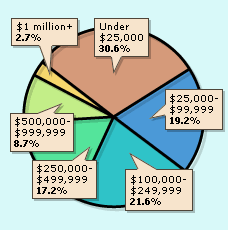
Source: Claritas, December 2003 data
So, now that you know where you stand, you can start your own thrift program. There is a video and how-to on WikiHow. You don't have to buy anything to be happy. Here's how to buy nothing."Annual income twenty pounds, annual expenditure nineteen pounds nineteen and six, result happiness. Annual income twenty pounds, annual expenditure twenty pounds ought and six, result misery."-- Mr Micawber in Charles Dickens' David Copperfield


 Posts
Posts

